6 Questions to Ask Before Buying Weight-Loss Medication Online
Buying a prescription medicine online can be entirely legitimate. It can also mean receiving an unapproved substance from a seller you cannot identify, with no one to call when something goes wrong. The difference is not obvious from the website.


These medicines work, which is exactly why a large market has grown around them, and why some of that market is careless and some of it is deliberately misleading. The questions below are the ones that reliably separate the two. A legitimate service will answer all six without hesitation.
1. Is this the approved medicine, a compounded version, or something else?
There are three tiers, and websites rarely make clear which one they are selling.
The approved product is the branded medicine made by the manufacturer and dispensed by a licensed pharmacy. It arrives in a sealed carton with a prefilled pen and a patient leaflet.
A compounded version is prepared by a compounding pharmacy. These are not FDA-approved products; approval applies to specific manufactured medicines, not to compounded preparations. The rules governing whether these may be made at all have shifted considerably since the shortages of 2023 and 2024 were declared resolved, and that question is still being litigated. If a site is selling compounded semaglutide or tirzepatide, ask directly which pharmacy makes it and on what legal basis.
Everything else is the category to avoid. The clearest warning sign is a product sold as a salt form — "semaglutide sodium" or "semaglutide acetate." The FDA has warned that these are chemically different from the approved active ingredient and have never been evaluated for safety, quality or effectiveness in people. Anything described as "for research use only" is in the same category, whatever the accompanying dosing instructions say.
2. Who is the prescriber, and are they licensed where I live?
A prescription requires a licensed clinician, and that clinician must hold a licence in the state where you are, not where the company is.
Reasonable questions: can I see the prescriber's name and credentials before I pay? Is there an actual consultation, by video or telephone, or only a form? Can I contact the same clinician afterwards with a question?
Some services run entirely on a questionnaire, with no identifiable prescriber and no route back to one. Requirements vary by state, and some do permit questionnaire-based intake — but a service that will not name the person writing your prescription is telling you something about how much clinical involvement to expect later.
3. Which pharmacy is dispensing it, and can I check them?
You can verify this yourself in a few minutes, and it is the single most useful check available to a patient.
The National Association of Boards of Pharmacy accredits legitimate online pharmacies and publishes a list of accredited sites. LegitScript certifies online healthcare merchants and maintains a similar lookup. If the dispensing pharmacy appears in neither, and especially if the site will not name a pharmacy at all, treat that as disqualifying.
Other markers of an illegitimate seller: no prescription required, prices far below everyone else, no physical address or phone number, and payment only by bank transfer or cryptocurrency.
4. How will I measure the dose?
This is the question almost nobody asks, and it causes real harm.
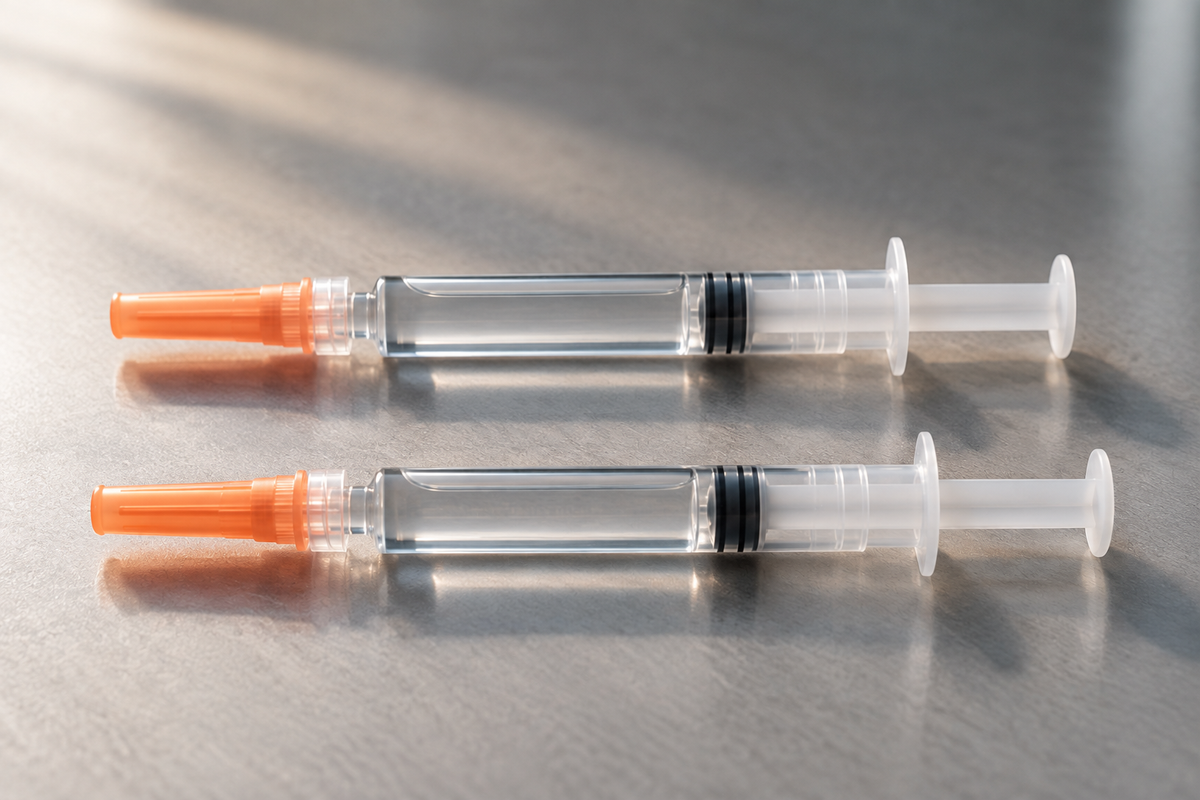
An approved prefilled pen delivers a fixed dose. A vial and syringe require you to know the concentration, read the markings correctly and calculate the volume — skills most people have never needed.
In 2024 the FDA warned about adverse events, some requiring hospitalisation, arising from dosing errors with compounded semaglutide in multiple-dose vials. Patients had drawn up far more than intended, in some cases many times the prescribed amount, and some prescribers had miscalculated when converting between milligrams, millilitres and syringe units. Reported harms included severe vomiting, dehydration, pancreatitis and gallstones.
If what arrives is a vial and a syringe rather than a pen, do not guess. Ask the prescriber to confirm, in writing, how many millilitres correspond to your dose at that specific concentration, and have a pharmacist or clinician watch you draw it up the first time.
5. What happens when something goes wrong?
Assume at some point you will have a question at an inconvenient moment, and work out in advance who answers it.
Is there a clinician reachable outside business hours? Will anyone follow up if you stop ordering? If you develop severe abdominal pain or cannot keep fluids down, is there a route back to the prescriber, or only a support email?
Keep the packaging, including any lot number, and tell your regular doctor what you are taking, even if you would rather not. If you do experience a serious problem, it can be reported to the FDA through MedWatch regardless of where the product came from.
6. What is the plan at month twelve, and what will it cost by then?
These are maintenance treatments. They work while you take them, and when they stop, appetite returns and weight tends to follow. That is how the medicine works rather than a failure, but it means the relevant question is not what the first month costs.
Ask what the price is after any introductory period, whether it rises with dose, and what happens if the service stops supplying your product — which has happened repeatedly in this market as rules and supply have changed. A plan that only works at the introductory price is not a plan.
It is also worth asking what support comes with the prescription beyond the medicine itself. Resistance training and adequate protein substantially change how much of the weight you lose is fat rather than muscle, and a service that never mentions either is selling a product rather than providing care.
Red flags, briefly
No prescription required. No named prescriber. No named pharmacy. "Research use only" anywhere on the site or the vial. Salt forms. Prices far below the market. Payment by cryptocurrency or bank transfer only. No physical address. Pressure to buy multiple months up front. Claims that the product is identical to the branded medicine.
The reasonable version of this
None of the above argues against telehealth. Remote prescribing is well established, convenient, and for many people the difference between getting treatment and not.
The distinction worth holding is between a service that happens to operate online and a seller that is online precisely to avoid the parts of healthcare that protect you. The first will answer these six questions directly. The second will answer none of them, and that silence is the most reliable information you will get.
If you are already taking something you are unsure about, bring it — the packaging, the vial, the paperwork — to a doctor and ask. That conversation is more useful than stopping quietly and saying nothing.
- [1]US Food and Drug Administration. FDA alerts health care providers, compounders and patients of dosing errors associated with compounded injectable semaglutide products. July 2024.
- [2]US Food and Drug Administration. Information about counterfeit and unapproved semaglutide products, including salt forms.Verify current consumer guidance page before publishing.
- [3]National Association of Boards of Pharmacy, Digital Pharmacy Accreditation, and LegitScript healthcare merchant certification.Confirm current verification tools and links at publication.
- [4]Wilding JPH, et al. Weight regain and cardiometabolic effects after withdrawal of semaglutide: the STEP 1 trial extension. Diabetes, Obesity and Metabolism. 2022;24(8):1553–1564.
The content on this site is provided for general information and education. It is not medical advice, and it is not a substitute for consultation with a qualified healthcare professional who knows your individual circumstances.
Many of the interventions discussed here are investigational. Some are available only within clinical trials; others are marketed directly to consumers without having been shown to be safe or effective for the purposes claimed. Nothing on this site should be read as a recommendation to start, stop or alter any treatment.
If you are considering a therapy you have read about here, discuss it with your own physician first.