What Is Regenerative Medicine? How Biology, Engineering and Clinical Innovation Work Together to Restore Function
Regenerative medicine seeks to restore the biological capacity for repair rather than simply compensate for lost function. It is best understood not as one treatment but as a coordinated platform connecting biology, engineering, manufacturing and individualised clinical care.
The field is broad by design. It encompasses stem-cell biology, tissue engineering, biomaterials, gene and molecular therapies, blood-derived products, physical signalling and the body's own repair mechanisms. Some regenerative treatments are established medical practice with decades of use behind them. Many others remain in clinical development.
Distinguishing between those two categories is the most useful thing a clinician or patient can learn to do in this field.
A field larger than stem cells
Regenerative medicine is often reduced to the phrase stem-cell therapy, but that description is incomplete. The field includes any carefully designed strategy intended to restore structure or function by influencing living systems. A treatment may deliver cells, recruit endogenous progenitor cells, provide a scaffold for new tissue, correct a molecular defect, modify immune signalling, or create a local environment in which repair can proceed.
The central question is not simply which product is being used. It is whether the intervention addresses the correct tissue, the correct biological mechanism and the correct stage of disease. The same therapy can behave quite differently depending on vascular supply, immune status, fibrosis, metabolic health, age, medications and the condition of the local tissue environment.
The four platforms
1. Cell-based therapies
Cell-based approaches use living cells to replace missing populations, regulate inflammation, deliver biological signals or support tissue remodelling. Examples include haematopoietic stem-cell transplantation, cultured epithelial grafts, immune-cell therapies, and investigational mesenchymal stromal-cell or pluripotent stem-cell-derived products.
Source, identity, purity, potency, dose, route and manufacturing controls all influence clinical behaviour. Two products described by the same name can differ substantially on every one of those variables.
2. Tissue engineering and biomaterials
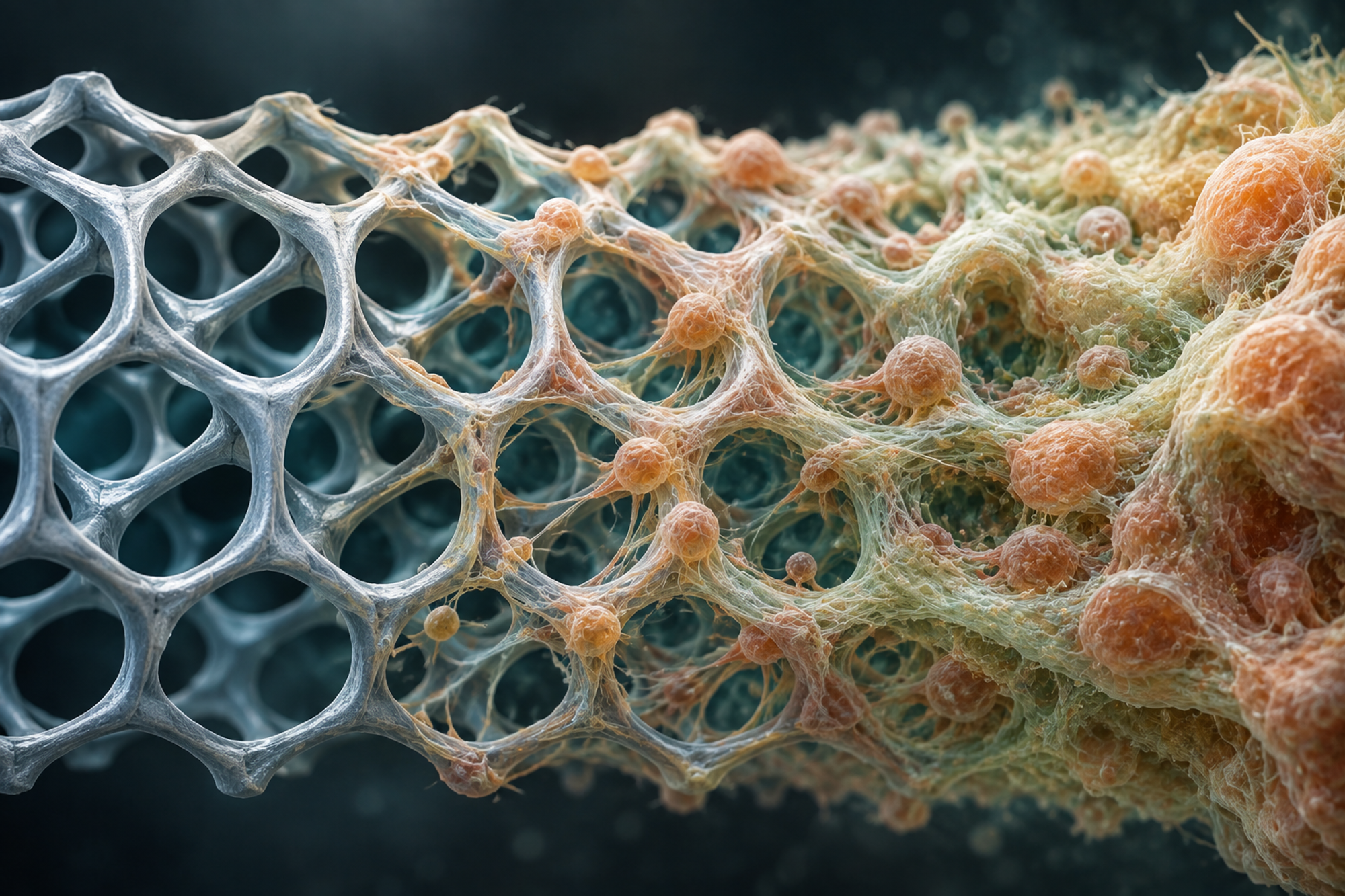
Tissue engineering combines cells with scaffolds, matrices or devices that reproduce part of the physical environment of native tissue. Biomaterials may provide structural support, control the release of growth factors, or guide cells toward organised repair. Applications range from skin substitutes and cartilage constructs to vascular grafts, organoids and three-dimensional bioprinting research.
3. Gene, molecular and signalling therapies
Regeneration can also be directed through genes, RNA, proteins, peptides, cytokines, growth factors and extracellular vesicles. These tools aim to alter cellular instructions or communication rather than to supply new cells.
Gene-modified cells illustrate how multiple platforms converge: cells are collected, engineered, expanded, characterised and then returned as a personalised biological medicine.
4. Endogenous repair and the tissue environment
The body already contains repair systems, but their performance depends on oxygen delivery, metabolic energy, immune balance, extracellular matrix quality and mechanical loading. Rehabilitation, photobiomodulation, targeted nutrition, sleep, movement and condition-specific physical therapies may be used to support this environment.
These measures do not replace a cellular product. They influence the biological terrain in which that product must function — which is often the difference between a therapy working and not working.
How regenerative therapies are designed
A regenerative treatment is a chain of linked decisions, and a weakness at any link limits everything downstream.
- Define the target. Identify the tissue, mechanism, disease stage and realistic clinical objective.
- Select the platform. Choose cells, biomaterials, genes, signalling molecules or a combined approach.
- Characterise the product. Confirm identity, purity, potency, sterility, stability and dose.
- Prepare the patient. Address infection, inflammation, metabolic stress, perfusion and relevant procedural risks.
- Deliver and monitor. Use an appropriate route, predefined outcomes and longitudinal safety surveillance.
Delivery must place the therapy where it can survive, communicate and act. Follow-up must be capable of distinguishing a transient response from meaningful recovery of structure or function.
Established care and emerging innovation
Regenerative medicine spans a continuum, and conflating its ends is the most common source of confusion.
Haematopoietic stem-cell transplantation has decades of clinical use for selected blood and immune disorders. Engineered skin and epithelial products have established roles in specific settings. Several gene and gene-modified cell therapies are authorised for defined diseases.
At the same time, many uses of stromal cells, exosomes, peptides, organoids, bioprinting and tissue-specific progenitor cells remain investigational or condition-dependent.
Innovation is essential, but biological plausibility is not the same as a clinically characterised treatment. A credible programme identifies what is established, what is investigational and what is exploratory. It also specifies the product source, processing, release criteria, route, dose, expected response and monitoring plan. That transparency is what allows patients, clinicians and investors to evaluate a programme on its actual capabilities rather than on its ambitions.
The patient journey
Regenerative care begins with diagnosis and tissue staging, not with product selection. Imaging, laboratory markers, functional measures and prior treatment history help define whether the problem is primarily inflammatory, degenerative, ischaemic, fibrotic, mechanical or mixed. The treatment plan then aligns the regenerative platform with the biology of that particular patient.
- Baseline assessment and clear functional goals.
- Review of contraindications, medications, immune status and infection risk.
- Product documentation, informed consent and procedural planning.
- Support of nutrition, mobility, sleep, perfusion and rehabilitation where relevant.
- Scheduled reassessment using the same objective measures collected at baseline.
What a high-quality programme should document
Six questions, and a programme that cannot answer them clearly has told you something important.
Therapeutic identity. What exactly is being administered, and how is it characterised?
Manufacturing quality. Where is it produced, under which controls, and how are sterility and potency assessed?
Clinical rationale. What tissue and mechanism are being targeted?
Delivery strategy. Why were this route, dose and schedule selected?
Outcome plan. Which safety, imaging, laboratory and functional measures will be tracked?
Contingency plan. What happens if the patient does not respond, or experiences an adverse event?
The next generation
The future of regenerative medicine will likely be defined by combination strategies. Cells may be paired with smart biomaterials, gene editing, targeted delivery, artificial intelligence-assisted manufacturing and real-time biomarkers. Patient-specific induced pluripotent stem cells may improve disease modelling and enable more individualised products. Organoids and organ-on-chip systems may help predict response before treatment.
Extracellular vesicles and cell-free secretomes may eventually deliver selected signals without transplanting whole cells, though standardisation remains a central unsolved challenge.
Progress will depend on more than discovery. Reproducible manufacturing, long-term surveillance, ethical governance, transparent communication and access will determine whether promising technologies become dependable clinical tools.
Conclusion
Regenerative medicine is a multidisciplinary effort to restore living function. It includes established therapies, rapidly advancing clinical programmes and exploratory technologies, and it does not serve patients well to blur the boundaries between them.
Its strength lies in combining precise diagnosis with the right biological platform, high-quality manufacturing, an appropriate delivery strategy and disciplined follow-up. The most useful question is therefore not whether regenerative medicine works as a single category, but which regenerative approach is appropriate for a specific tissue, a specific patient and a specific clinical objective.
- [1]International Society for Stem Cell Research. Guidelines for Stem Cell Research and Clinical Translation. Published 2021; targeted update to stem cell-based embryo model sections, 2025.
- [2]International Society for Stem Cell Research. A Closer Look at Stem Cells: the ISSCR guide to stem cell treatments. Accessed September 2026.
- [3]US Food and Drug Administration. Consumer information on regenerative medicine products, including stem-cell and exosome products. Accessed September 2026.
- [4]National Institute of Biomedical Imaging and Bioengineering. Tissue engineering and regenerative medicine. National Institutes of Health. Accessed September 2026.
- [5]National Center for Biotechnology Information. 2026 watch list: regenerative medicine. NCBI Bookshelf, 2026.Verify exact title and availability before publishing.
The content on this site is provided for general information and education. It is not medical advice, and it is not a substitute for consultation with a qualified healthcare professional who knows your individual circumstances.
Many of the interventions discussed here are investigational. Some are available only within clinical trials; others are marketed directly to consumers without having been shown to be safe or effective for the purposes claimed. Nothing on this site should be read as a recommendation to start, stop or alter any treatment.
If you are considering a therapy you have read about here, discuss it with your own physician first.