How Peptide Hormones Signal Through Receptors: The Science in Plain Terms
A peptide hormone changes what a cell does without ever entering it. Understanding how that works explains most of what is otherwise puzzling about peptide therapeutics.

Here is the problem the body had to solve. A cell is wrapped in a membrane of lipid, which water-soluble molecules cannot cross. Peptides are water-soluble. So a peptide hormone circulating in blood cannot get inside its target cell, cannot reach the nucleus, and cannot directly touch the machinery that would need to change for the cell to behave differently.
And yet it does change that behaviour, within seconds, at concentrations measured in picomoles. The mechanism by which that happens is worth understanding properly, because it accounts for the dose sizes, the speed of onset, the importance of dosing schedule, and several clinical phenomena that look strange until you see the underlying architecture.
The lock is on the outside
The useful comparison is with steroid hormones, which solve the same problem in the opposite way.
Steroids are lipid-soluble. Testosterone, cortisol and oestradiol pass straight through the cell membrane, bind receptors inside the cell, and travel to the nucleus where they act directly on gene transcription. The consequences are slow, because making new protein takes time, and durable, because the change is at the level of what the cell is building.
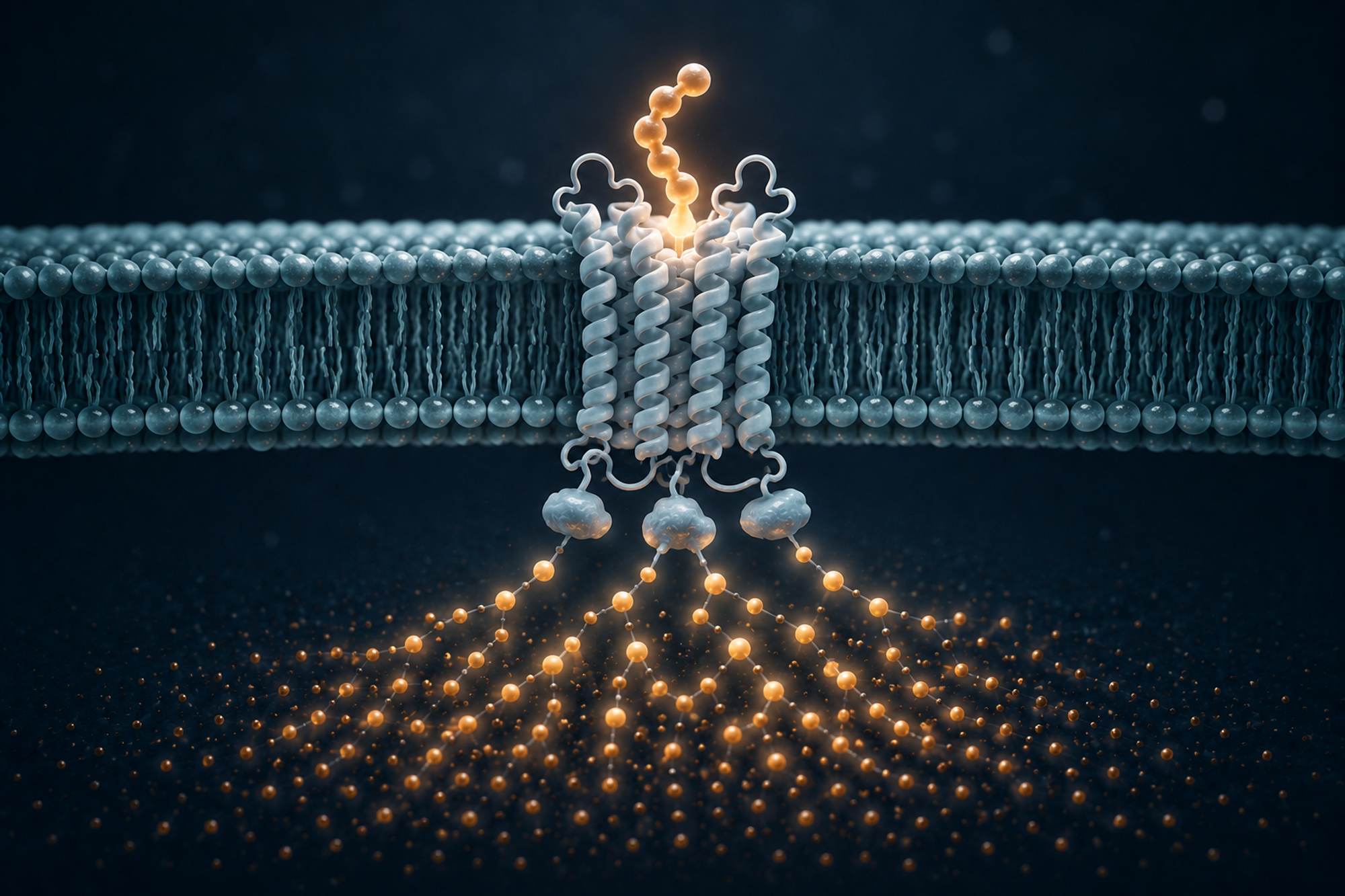
Peptides cannot do any of that. Their receptors sit in the membrane with a binding site facing outward, and the peptide docks there like a key in a lock mounted on the outside of a door. The peptide stays outside. What crosses the membrane is not the molecule but a change in the shape of the receptor.
That conformational change is the entire trick. The portion of the receptor projecting into the cell's interior shifts position, and that shift is what the cell reads. The hormone is the first messenger; what it triggers inside is the second messenger. The message has been relayed rather than delivered.
This is also why peptide effects are fast. Nothing has to be transcribed or translated for the initial response. Existing proteins are switched on by chemical modification, which happens in seconds to minutes rather than hours to days.
Three ways across
Most clinicians remember one receptor architecture. There are three that matter for peptide hormones, and knowing which applies explains a good deal about a given drug's behaviour.
G protein-coupled receptors. The largest group. GLP-1, GHRH, PTH, glucagon, calcitonin, ghrelin, somatostatin, GnRH and the melanocortins all act here. The receptor threads through the membrane seven times, and when the peptide binds, the intracellular portion engages a G protein, which then activates an enzyme that generates second messengers.
Receptor tyrosine kinases. Insulin and IGF-1 use these. Binding causes two receptor halves to pair up and phosphorylate each other on tyrosine residues, creating docking sites for intracellular adaptor proteins and launching the PI3K/Akt pathway. The receptor is itself an enzyme, which is a structurally different solution to the same problem.
Cytokine receptors signalling through JAK/STAT. Growth hormone, prolactin and leptin work this way. Binding brings receptor chains together, associated JAK kinases phosphorylate STAT proteins, and the STATs travel to the nucleus to act on transcription. This is the peptide route that most closely resembles what steroids do directly.
Amplification, and why the doses are so small
Follow a single GLP-1 molecule binding a single receptor.
The receptor engages a Gs protein. The Gs protein activates adenylyl cyclase. That one enzyme molecule then produces many molecules of cyclic AMP. Each cAMP contributes to activating protein kinase A. Each activated PKA molecule phosphorylates many target proteins. At every step, one upstream event produces multiple downstream events.
The result is a cascade in which a handful of binding events at the surface produces a substantial change in the cell's internal chemistry. This is why therapeutic peptides are dosed in micrograms to low milligrams while the same patient eats sixty to a hundred grams of protein daily. The peptide is not supplying material. It is pulling a lever that is itself attached to a much larger mechanism.
Amplification also explains why receptor distribution rather than injection site determines where effects appear. A subcutaneous injection in the abdomen produces effects in the pancreas, stomach, brain and cardiovascular system because that is where the receptors are.
Same architecture, opposite answers
A common misconception is that binding a receptor means switching something on. It does not. What happens depends on which G protein the receptor recruits.
Gs stimulates adenylyl cyclase and raises cAMP. Glucagon does this in hepatocytes, driving glucose output.
Gi inhibits adenylyl cyclase and lowers cAMP. Somatostatin does this, which is why it suppresses so many secretory processes.
Gq activates phospholipase C, generating IP3 and diacylglycerol, releasing intracellular calcium and activating protein kinase C. GnRH does this in pituitary gonadotrophs.
So two peptides can bind structurally similar receptors and produce opposite cellular outcomes. The receptor is not a switch. It is a coupling, and what it couples to determines the direction of the effect. This is worth holding onto when evaluating claims that a peptide "activates" some system: activation of what, coupled to which pathway, in which tissue.
Timing is part of the message
This is the section with the most clinical consequence, and the part most often missed.
Receptors do not respond indefinitely to continuous stimulation. Sustained occupancy triggers desensitisation: the receptor is phosphorylated, β-arrestin binds, the receptor uncouples from its G protein and is internalised. The cell stops listening. Restoration requires the signal to stop for long enough for receptors to recycle back to the surface.
The consequence is that a hormone delivered continuously and the same hormone delivered in pulses are not the same signal at different intensities. They are different instructions.
The definitive example is GnRH. Delivered in physiological pulses, it stimulates gonadotrophin release, which is how the reproductive axis normally runs. Delivered continuously as a long-acting agonist, it initially stimulates — producing the well-recognised testosterone flare in the first weeks of leuprolide therapy — and then causes profound receptor downregulation and suppression of the axis. The same receptor, occupied by an agonist, produces suppression. That result is unintelligible if you think of receptor binding as simply switching something on, and entirely predictable once desensitisation is part of the model.
The same principle sits underneath the argument for secretagogues preserving pulsatility, and underneath a question that deserves more attention than it gets: when half-life engineering converts a peptide that circulated for two minutes into one that circulates for a week, the drug is not delivering the native signal for longer. It is delivering a categorically different temporal pattern, and the receptor responds to pattern as well as to presence.
What this means for drug design
Three implications follow, and they explain much of what the current generation of peptide drugs is doing.
Biased agonism. Because receptors couple to more than one intracellular partner — G proteins and β-arrestin among them — a ligand can be designed to favour one route over another. In principle this allows the therapeutic branch of a pathway to be engaged while the branch responsible for desensitisation or an unwanted effect is engaged less. In practice this is difficult, but it is an active design strategy rather than a theoretical one.
Multi-receptor agonism. Tirzepatide engages both GIP and GLP-1 receptors; retatrutide adds the glucagon receptor. These are not higher doses of the same idea. They are attempts to produce a combination of signals that no single endogenous hormone produces, on the reasoning that metabolic regulation is a multi-input system.
Dosing schedule as a design variable. If pattern is part of the message, then interval is not merely a convenience question. It is pharmacologically substantive, and comparing two products with the same receptor target but different half-lives requires attention to what pattern each actually produces.
What mechanism does and does not tell you
Understanding this architecture is genuinely useful. It explains dose magnitude, onset speed, tissue distribution of effects, the flare phenomenon, and why dosing schedules are not arbitrary.
What it does not do is establish that engaging a given receptor produces clinical benefit. A mechanism can be elegant, well characterised and entirely real while the intervention built on it fails to help anyone. The history of drug development is substantially a history of sound mechanisms that did not translate.
That distinction matters particularly in this field, where mechanistic plausibility is frequently offered as though it were evidence of effect. It is a reason to run the trial, not a substitute for having run it.
For where the peptide/protein boundary falls and why it determines regulatory pathway, see What are peptides? A clinician's primer on peptide vs protein signalling.
- [1]Muttenthaler M, King GF, Adams DJ, Alewood PF. Trends in peptide drug discovery. Nature Reviews Drug Discovery. 2021.Receptor targets and design strategies across approved peptide therapeutics.
- [2]Standard endocrinology and pharmacology texts cover GPCR, receptor tyrosine kinase and JAK/STAT signalling in detail.Select a preferred textbook or review citation before publishing.
- [3]Reviews of GnRH agonist pharmacology describe the initial gonadotrophin flare followed by receptor downregulation under continuous stimulation.Verify preferred citation before publishing.
The content on this site is provided for general information and education. It is not medical advice, and it is not a substitute for consultation with a qualified healthcare professional who knows your individual circumstances.
Many of the interventions discussed here are investigational. Some are available only within clinical trials; others are marketed directly to consumers without having been shown to be safe or effective for the purposes claimed. Nothing on this site should be read as a recommendation to start, stop or alter any treatment.
If you are considering a therapy you have read about here, discuss it with your own physician first.