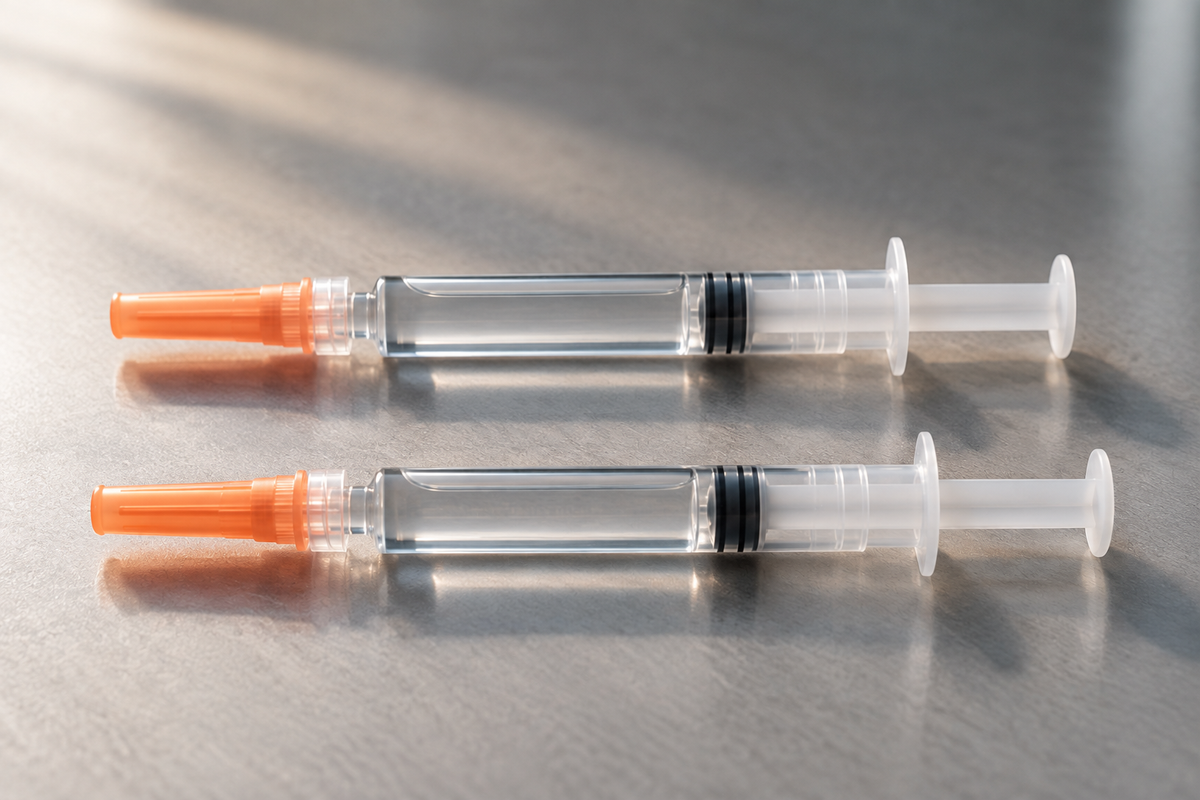
What are peptides? A Clinician's Primer on Peptide vs Protein Signaling
Peptides and proteins are built from the same amino acids. The distinction between them is partly conventional, but it determines how these molecules behave in the body, how they are manufactured, and which regulatory framework governs them.

Ask most patients what a peptide is and the answer will be some version of "a small protein." That is not wrong, but it explains very little. The reason peptides have become a distinct therapeutic category has less to do with size than with role. Most therapeutic peptides carry information between cells. Most proteins do structural, catalytic or transport work. Once that distinction is clear, a good deal follows from it: why peptide doses are measured in micrograms rather than grams, why almost all of them are injected, why dietary protein intake has no bearing on peptide therapy, and why the compounding rules governing this category have changed twice in three years.
Where the line actually falls
Amino acids joined by peptide bonds form a chain. Short chains are peptides, long chains are proteins, and the transition between them is a matter of convention rather than chemistry. Textbooks have variously placed it at 20, 50 or 100 residues.
In the United States, that ambiguity was settled administratively. The FDA's final rule defining "biological product," effective March 2020, interprets protein to mean any alpha amino acid polymer with a specific, defined sequence greater than 40 amino acids in size. [1]
A chain of 40 residues or fewer falls outside that definition and is regulated as a drug under a New Drug Application. A longer chain is a biologic and requires a Biologics License Application.
This is not a semantic exercise. The pathway determines manufacturing standards, review requirements, comparability expectations, and whether a generic or a biosimilar is even possible. Insulin, at 51 amino acids, sits above the line and was reclassified as a biologic when the rule took effect — a molecule the field had comfortably called a peptide hormone for a century.
Signal versus substrate
The functional distinction is the one that matters at the bedside, and it is the one patients most often get wrong.
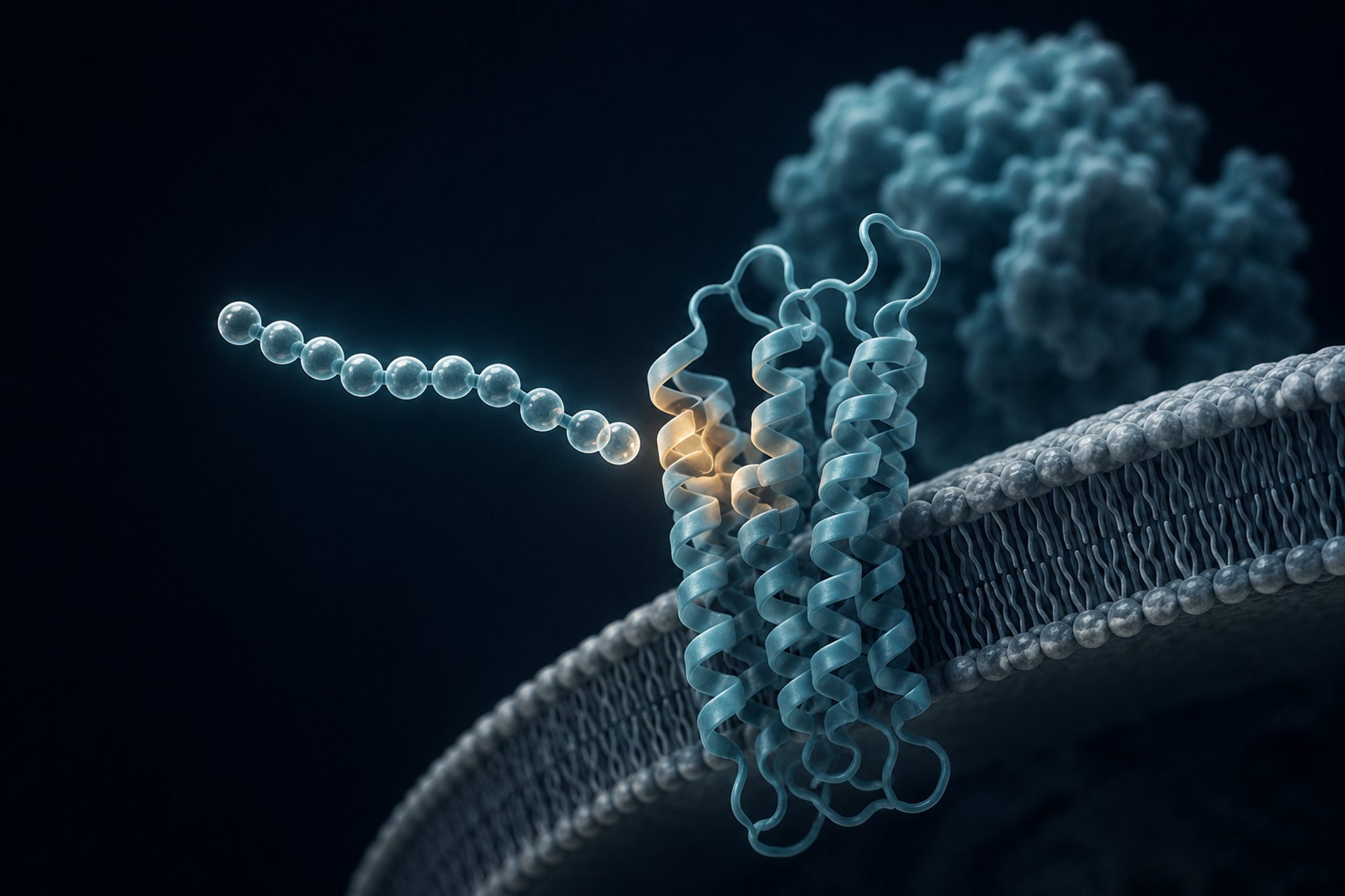
A signalling peptide works by binding a receptor. Its job is to be recognised, not to be consumed. Glucagon-like peptide-1, gonadotrophin-releasing hormone, growth hormone-releasing hormone, somatostatin, oxytocin and parathyroid hormone all operate this way: they carry a message from one tissue to another, are recognised by a specific receptor, and are then cleared. The molecule is not incorporated into anything. It is read and discarded.
Dietary protein does something entirely different. Gastric and pancreatic proteases, followed by brush-border peptidases, reduce ingested protein largely to free amino acids and di- and tripeptides, which are absorbed through dedicated transporters and enter the body's amino acid pool. That pool is substrate. It supports synthesis of the patient's own peptides and proteins, and adequate intake is a genuine prerequisite for the endocrine system to function. But eating more protein does not deliver more signal, in the same way that stocking more paper does not produce more letters.
This is worth stating plainly to patients, because the marketing around collagen peptides and protein supplementation frequently blurs it. The nuance is that oral degradation is not absolute — certain small dipeptides derived from collagen hydrolysate have been detected in circulation — but detecting a fragment in plasma is a long way from demonstrating that a therapeutic signal has been delivered to a receptor at a meaningful concentration.
How peptide signalling works
Most peptide hormones act at G protein-coupled receptors on the cell surface. GLP-1, GHRH, PTH, glucagon and calcitonin bind class B GPCRs; ghrelin and the growth hormone secretagogues act at GHS-R1a; the melanocortin peptides act across the MC1R–MC5R family.
Two features of this arrangement explain most of the clinical pharmacology.
The first is affinity. These receptors bind their ligands in the nanomolar to picomolar range, which is why therapeutic doses are so small. Semaglutide is dosed at up to 2.4 mg once weekly; tesamorelin at low single milligrams daily. Compare that with the 60 to 120 grams of dietary protein the same patient eats each day. Peptide therapy operates several orders of magnitude below nutritional dosing because it is not supplying material.
The second is amplification. A single ligand–receptor binding event activates a G protein, which activates adenylyl cyclase, which generates many molecules of cyclic AMP, which activate protein kinase A, which phosphorylates many downstream targets. A few micrograms of peptide can therefore produce a substantial cellular response. It also means that receptor distribution, not injection site, determines where effects appear — GLP-1 receptor agonists act on the pancreas, gut, brain and cardiovascular system because the receptor is expressed in all of them.
Why peptides are difficult to formulate
The same properties that make peptides precise signals make them awkward drugs. They are protease substrates, they are cleared rapidly by the kidney, and they cross membranes poorly.
Native GLP-1 illustrates the problem. Its circulating half-life is roughly two minutes, because dipeptidyl peptidase-4 cleaves it almost immediately. [2]
As an endogenous signal that is a design feature: an incretin released with a meal should not persist. As a drug it is unusable.
Every marketed GLP-1 receptor agonist is an answer to that problem. Sequence substitution at the DPP-4 cleavage site blocks enzymatic degradation. Acylation with a fatty diacid chain promotes reversible albumin binding, creating a circulating reservoir that releases drug slowly and reduces renal clearance. The result in semaglutide's case is a half-life of about a week from a starting molecule that lasted minutes.
Oral delivery remains the harder problem. Oral semaglutide is co-formulated with the absorption enhancer SNAC, which buffers local gastric pH and promotes uptake, and it still achieves bioavailability on the order of one percent. That is why the oral dose is measured in milligrams where the injectable dose is measured in fractions of one.
Secretagogues are not replacement
A distinction that repeatedly causes confusion in longevity practice: some peptides replace a signal, and some prompt the body to produce its own.
Growth hormone-releasing hormone analogues and ghrelin-receptor secretagogues act upstream, on the pituitary. They require an intact axis to work, they preserve pulsatile release, and they remain subject to negative feedback from IGF-1 and somatostatin. Recombinant human growth hormone bypasses all of that and delivers the effector directly.
The two are pharmacologically different interventions with different safety considerations, different monitoring requirements and different failure modes, and they should not be discussed interchangeably. A secretagogue that works only where the axis is intact will do nothing in a patient whose pituitary is not responsive — which is a diagnostic question, not a dosing one.
Identity, purity and the current regulatory position
Because a peptide's entire activity is encoded in its sequence, identity and purity are not manufacturing niceties. A truncated chain, a deletion, a D-amino acid substitution or an aggregated impurity can abolish activity or generate immunogenicity. Peptides are generally less immunogenic than large proteins, but anti-drug antibodies do occur, and process-related impurities raise that risk.
That concern sits at the centre of the current US regulatory dispute. In late 2023 the FDA moved 19 widely used peptides — among them BPC-157, CJC-1295, ipamorelin, thymosin alpha-1, epitalon and KPV — to Category 2 of the 503A bulk substances list, the designation for substances presenting significant safety concerns, effectively removing them from legal compounding. [3]
The stated grounds included immunogenicity, manufacturing impurities and the absence of adequate human data.
The position has since shifted. In February 2026, HHS announced that most of those substances would be moved back toward Category 1, and the Pharmacy Compounding Advisory Committee met on 23 and 24 July 2026 to review seven of them. [4]
The committee recommended six — BPC-157, KPV, TB-500, MOTS-c, semax and epitalon — for inclusion on the 503A list, in a series of narrow votes that went against the written recommendation of the FDA's own review staff. Emideltide was the single rejection. A further meeting covering additional peptides is anticipated in 2027.
The reviewers' central objection is worth understanding, because it is a chemistry objection rather than an efficacy one: without universally accepted chemical definitions for these substances, identity, quality and batch-to-batch comparability cannot be established, which makes safety and effectiveness difficult to assess at all. That criticism applies with equal force whatever one concludes about the underlying biology.
What a primer can settle, and what it cannot
The peptide/protein distinction is genuinely useful and genuinely clarifying. It explains dosing, route, half-life and regulatory pathway, and it disposes of the common assumption that dietary protein and peptide therapy are versions of the same thing.
What it does not do is tell you whether any particular peptide works. Understanding that a molecule binds a receptor with high affinity says nothing about whether engaging that receptor produces clinical benefit in a given patient. Those are separate questions requiring separate evidence, and for most of the peptides now being discussed in longevity practice, that evidence is preclinical rather than clinical. Holding both facts together — sound mechanism, thin human data — remains the honest position.
- [1]US Food and Drug Administration. Definition of the Term "Biological Product." Final rule, 85 FR 10057, effective 23 March 2020; codified at 21 CFR 600.3(h)(6).Regulatory definition of protein and the 40-amino-acid threshold.
- [2]Reviews of GLP-1 receptor agonist pharmacokinetics describe a native GLP-1 half-life of approximately two minutes secondary to DPP-4 cleavage.Verify preferred citation before publishing.
- [3]US Food and Drug Administration. Certain Bulk Drug Substances for Use in Compounding That May Present Significant Safety Risks (Category 2), September 2023 update.Verify current wording and list contents at time of publication.
- [4]US Food and Drug Administration. Meeting of the Pharmacy Compounding Advisory Committee, 23–24 July 2026.Committee recommendations; not a final agency action.
The content on this site is provided for general information and education. It is not medical advice, and it is not a substitute for consultation with a qualified healthcare professional who knows your individual circumstances.
Many of the interventions discussed here are investigational. Some are available only within clinical trials; others are marketed directly to consumers without having been shown to be safe or effective for the purposes claimed. Nothing on this site should be read as a recommendation to start, stop or alter any treatment.
If you are considering a therapy you have read about here, discuss it with your own physician first.